Maxillofacial Surgery in Ahmedabad
8,000+
50–70
10+
4.9
2
3
What is maxillofacial surgery?
Maxillofacial surgery for tumours — who this service is for
✓ This service is for you if:
- You have a lump, swelling or growth in the jaw, mouth or face that keeps getting bigger
- An X-ray, CT or MRI has shown a cyst or tumour inside the jaw bone
- Your biopsy names ameloblastoma, odontogenic keratocyst, myxoma or another jaw lesion
- An oral or mouth cancer has grown into the jaw bone
- You need the jaw or face rebuilt after a tumour has been removed
- You have a tumour that has come back in an operated or irradiated area
- You have been told elsewhere that the tumour cannot be operated
- A child has a diagnosed cancer of the face or jaws — children with cancer are treated here
✕ This service is not for:
- Acute facial injury and jaw fractures needing emergency trauma care
- Corrective jaw surgery (orthognathic surgery) for bite or appearance
- Impacted wisdom teeth, routine extractions, or dental implants on their own
- Jaw-joint (TMJ) pain, clicking and locking
- Cleft lip and cleft palate repair
- Cosmetic facial reshaping where there is no disease
For these we point you to a general maxillofacial or dental unit rather than take the appointment. Tumours reaching the sinuses, orbit or skull base are treated here too — send the scan and we will tell you.
Jaw, mouth and facial conditions we treat
Ameloblastoma
Odontogenic keratocyst
Odontogenic myxoma
Dentigerous & radicular jaw cysts
Oral cancer invading the jaw
Tumours of the upper jaw & hard palate
Osteosarcoma & sarcomas of the jaw
Salivary gland tumours
Oral submucous fibrosis with change
Vascular lesions of the jaw and face
Recurrent tumours after earlier surgery
An undiagnosed jaw or facial swelling
Not sure which one your report names? Send the biopsy report and the scan.
What maxillofacial surgery protects — your face, bite, speech and swallowing
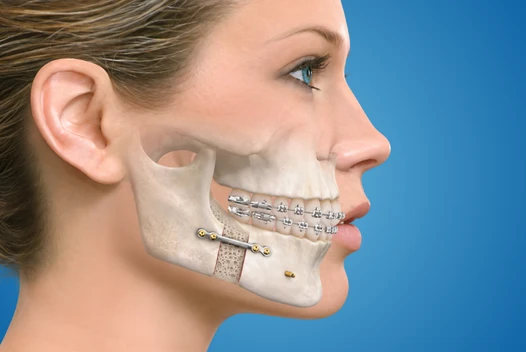
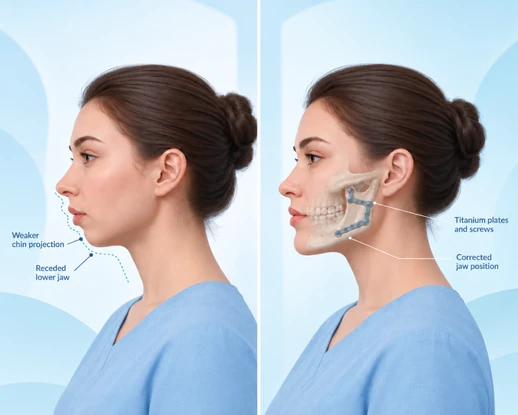
- The shape of your face. The jaw is what gives the lower face its outline. Rebuilding it with bone, in the same sitting, is what keeps the face from collapsing inward.
- Your bite and chewing. Restoring the height and arc of the jaw is what later allows implants and teeth, so you chew rather than blend your food.
- Your speech. The jaw, palate and tongue work together to shape sound. Closing a defect properly keeps speech clear instead of nasal or slurred.
- Your swallowing. Keeping the mouth sealed and the tongue mobile is what lets you drink and swallow without choking.
- The nerve to your lip and chin. Where disease allows, the inferior alveolar nerve is preserved or grafted, so the lower lip keeps sensation.
Why waiting costs you more jaw
A jaw tumour does not stay the same size
- Less bone removed. Earlier maxillofacial surgery means a marginal resection instead of a segmental one — the lower border of the jaw stays intact.
- A simpler reconstruction. A smaller defect may need no flap at all, which means a shorter operation and a faster recovery.
- Your own teeth kept. Teeth in the involved segment go with it. The smaller the segment, the more of your own bite survives.
- Fewer recurrences. A lesion removed properly the first time is far less likely to bring you back to theatre.
- For cancer, the neck matters too. An oral cancer left alone reaches the neck nodes — read the signs and symptoms of oral cancer .
Types of maxillofacial surgery we perform
Enucleation & curettage
Marginal mandibulectomy
Segmental mandibulectomy
Maxillectomy — partial or total
Neck dissection
Microvascular free-flap reconstruction
Minimally invasive & laser-assisted approaches
Salvage surgery for recurrence
Jaw and facial reconstruction after maxillofacial surgery
- The jaw is rebuilt with real bone. A free fibula flap takes bone from the leg with its blood vessels, shapes it to the curve of your jaw, and joins it under the microscope. Walking is not affected.
- It happens in the same operation. You do not wake up with a gap in your face waiting for a second surgery months later.
- Soft tissue is replaced with soft tissue. Where lining, cheek or floor of mouth has been removed, a soft-tissue flap restores bulk so the mouth still works.
- The upper jaw has two routes. A maxillectomy defect is closed either with a flap or with an obturator prosthesis that plugs the gap and restores speech and swallowing.
- Teeth can come later. Once the reconstructed bone has healed, implant-borne teeth can be planned so the bite is rebuilt as well as the jaw.
- Scars are planned, not accidental. Incisions follow natural creases and shadow lines of the face wherever the tumour permits.
Is the tumour operable? Get a second opinion on your scans
Send the reports
Personal review by Dr Smit
An honest answer, in writing
Sometimes “inoperable” is the truthful answer
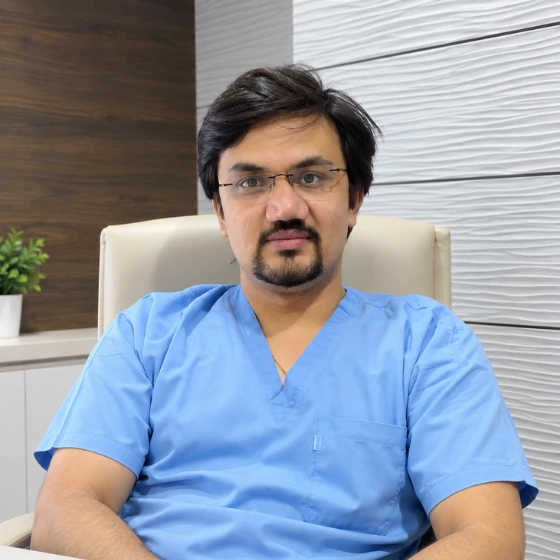
Meet your surgeon — Dr Smit A. Desai
- BDS, 2007–2012
- MDS — Oral & Maxillofacial Surgery, 2013–2016, College of Dental Sciences and Research Centre, Bopal, Ahmedabad
- Fellowship in Oral Oncology, 2017–2019 — first batch of AOMSI
- Travelling Fellowship in Head & Neck Oncology, April 2018 — FHNO
- Junior Consultant, Head & Neck Oncology, Shankus Medicity, Mehsana
- Member — AOMSI · IAOO · IAOMS · FHNO
- Best poster, 6th World Congress 2017, IAOO Bangalore
- Speaker at 20+ national and international conferences
Why choose Dr Smit for maxillofacial surgery
The specialty's own degree
Published in this anatomy
Operating microscope on site
4.9 from 261 Google reviews
Honest scope
Recurrent & "inoperable" cases reviewed
One pathway, one city
A written estimate before you decide
3 clinics across Ahmedabad
Book your maxillofacial surgery consultation
Send your scan and biopsy report on WhatsApp for an honest opinion on whether the tumour can be operated.
Also 087349 54487 (Maninagar) · 098983 48601 (Nikol) · drsmitdesai111@gmail.com · Mon–Sat 10am–2pm & 5–8pm
Maxillofacial surgery — frequently asked questions
What is the difference between maxillofacial surgery and oral surgery?
Oral surgery deals mainly with the teeth and the bone immediately around them — extractions, impacted wisdom teeth and small cysts. Oral and maxillofacial surgery is the wider specialty that also covers the jaws, face and neck, including tumours and reconstruction.
Is faciomaxillary surgery the same as maxillofacial surgery?
Yes. Faciomaxillary and maxillofacial describe the same specialty, and faciomaxillary surgery is simply the wording used more often in Indian hospitals. The training and the qualification are identical.
Do you treat facial fractures or do corrective jaw surgery?
No. This practice is limited to tumours, cysts and cancers of the jaw, mouth and face, and the reconstruction that follows. For facial injury, orthognathic surgery, TMJ problems, wisdom teeth or cleft repair we will point you to a general maxillofacial unit instead of taking the appointment.
Is a jaw tumour always cancer?
No — many jaw tumours, such as ameloblastoma and keratocyst, are benign. They still need proper surgery because they destroy bone as they grow and recur if they are only scraped out. Only a biopsy can tell you which you have.
Will my face look different after maxillofacial surgery?
The aim is that it does not. When jaw bone is removed it is rebuilt in the same operation with bone from your own leg, shaped to your jaw, so facial outline is preserved. Incisions are planned along natural creases wherever the tumour allows.
Will I be able to eat and speak normally again?
Most patients return to speech and a normal diet, though it takes time and often speech and swallowing therapy. Rebuilding the height and shape of the jaw is what makes implants and chewing possible later.
What affects the cost of maxillofacial surgery?
The diagnosis, how much jaw has to be removed, the type of reconstruction, theatre and ward time, implants or a prosthesis, and whether radiotherapy follows. We do not publish a fixed price because two patients with the same report can need very different operations — you get a free written, itemised estimate once your scans are read. Government schemes are not accepted; cashless and reimbursement insurance claims are supported.
How long does recovery take?
Recovery from maxillofacial surgery depends on the size of the operation. Expect several days in hospital after a major jaw resection with reconstruction, and a few weeks before eating and speech settle — longer when a free flap is used, and longer again if radiotherapy follows.
Will I need radiotherapy after the operation?
For benign jaw tumours, usually not — surgery alone is the treatment. For malignant tumours it depends on the final pathology report, which is discussed after surgery.
Can I get a second opinion if I have been told the tumour is inoperable?
Yes, and it is worth doing. Send the biopsy report and the scan on WhatsApp and Dr Smit will review them personally and tell you honestly whether surgery is possible.