Home › Oral cancer care › Oral submucous fibrosis treatment
Oral Submucous Fibrosis Treatment
If your mouth opens less than it used to, spicy food burns, and your cheeks feel tight, that is oral submucous fibrosis — and it does not settle on its own. Oral submucous fibrosis treatment at Heyansh Oral Cancer Hospital in Ahmedabad runs in stages, from medical care and physiotherapy through to band-release surgery when the stiffness is severe.
Is your mouth opening less than it used to?
This is the single most useful thing you can check before you see anyone. Put your index, middle and ring fingers together and try to fit them vertically between your upper and lower front teeth.
Most people manage three fingers comfortably. If you have started managing only two, or one, the fibrosis has already been building for a while. Oral submucous fibrosis treatment is planned around this measurement, so it is worth checking before your appointment.
Normal range
Roughly 35 mm or more between the front teeth. If you chew gutka or supari and still open normally, this is the moment to stop — before stiffness starts.
Early stiffness
Around 25–35 mm. Burning with spice is usually the first complaint. This stage normally responds to non-surgical care.
Moderate fibrosis
Roughly 15–25 mm. Bands can usually be felt in the cheeks. Eating and dental work both start becoming difficult.
Severe fibrosis
Under about 15 mm. Surgery is usually discussed at this stage, because dense bands rarely stretch with exercises alone.
Use this as a rough guide, not a diagnosis. Finger-width varies from person to person, and your surgeon will measure the actual distance between your front teeth and feel for bands. What the check is genuinely good for is noticing direction — whether this month is worse than six months ago.
What oral submucous fibrosis is
Oral submucous fibrosis, often shortened to OSMF, is a long-term scarring disease of the lining of the mouth. The soft, stretchy tissue inside your cheeks, under the palate and around the throat is slowly replaced by dense, inflexible fibrous tissue.
The cause, in the overwhelming majority of cases in India, is areca nut — supari, and the gutka, mawa and pan masala made from it. Arecoline in the nut drives the tissue to lay down collagen and stops it being cleared away, so scar tissue accumulates month after month.
It is also classed as a potentially malignant disorder, which simply means oral cancer can develop in mucosa affected by it. That is why anyone with OSMF stays under periodic review rather than being treated once and discharged.
An important correction. Stopping areca nut is essential and it is the precondition for everything else working — but stopping does not, by itself, melt away scarring that has already formed. Published reviews are clear that established fibrosis does not regress on cessation alone. Quitting halts the process; treatment is what improves it.
Signs of oral submucous fibrosis
The early signs are easy to dismiss, which is why most people arrive when opening is already restricted.
Burning with spicy food
Usually the very first symptom, and often the only one for months.
Mouth opening less
Noticed while eating a large bite, yawning, or at the dentist.
Pale, marble-like cheeks
The lining loses its pink colour and looks blanched and tight.
Bands you can feel
Firm vertical cords inside the cheeks or under the jaw.
Dryness and altered taste
Less saliva, and food starting to taste flat or different.
A stiff tongue or palate
Reduced tongue movement, difficulty swallowing, a changed voice.
Any ulcer, white patch, red patch or lump that lasts more than three weeks needs looking at separately and promptly — those are the signs and symptoms of oral cancer, not of fibrosis alone, and the two can exist together.
Can oral submucous fibrosis be cured?
Is oral submucous fibrosis curable? You deserve a straight answer, because the internet gives you two wrong ones.
Scarring that has already formed does not reverse. There is no tablet, oil, kit or home remedy that turns fibrous tissue back into normal lining. Anyone promising a complete cure is not being straight with you.
But that is not the same as untreatable. Progression can be halted, burning can be settled, and mouth opening can be improved substantially — often back to a range where you eat, speak and get dental work done comfortably. For many people that is the outcome that actually matters.
What treatment can do
- Stop the fibrosis getting worse
- Relieve burning and sensitivity
- Increase how wide your mouth opens
- Make eating and dental care possible again
- Keep the lining under regular review
What treatment cannot do
- Return the lining to completely normal tissue
- Hold the gain if you keep chewing
- Work without daily mouth-opening exercises
- Remove the need for long-term check-ups
- Guarantee any particular final measurement
The Cochrane review of interventions for the management of oral submucous fibrosis gives a fair summary of how varied the evidence on individual treatments still is — which is precisely why oral submucous fibrosis treatment is matched to your stage rather than sold as one fixed package.
How oral submucous fibrosis treatment works
Oral submucous fibrosis treatment is best thought of as a ladder rather than a single procedure. Where you start depends on how stiff the tissue already is and how much your mouth opens.
Stopping areca nut completely
Not reducing — stopping. Nothing below this step holds if chewing continues.
Assessment and measurement
Your mouth opening is measured, bands are felt for, and any suspicious patch is examined. A biopsy is taken only if something looks like it needs one.
Medical treatment and physiotherapy
Injections into the affected tissue, nutritional support, and a daily stretching routine. This is where most early and moderate cases are managed.
Surgery, if the bands are dense
When opening stays severely restricted, the bands are released surgically and the raw area is resurfaced.
Long-term review
Because OSMF is a potentially malignant disorder, the lining is checked periodically for years, not weeks.
Non-surgical OSMF treatment
Most people who come early never need an operation. Non-surgical OSMF treatment combines three things, and it works only when all three are done together. This is the form oral submucous fibrosis treatment takes for most early and moderate cases.
Intralesional injections
Steroid and enzyme preparations injected directly into the stiff tissue over a course of sessions, to settle inflammation and soften bands.
Nutritional support
Antioxidants and micronutrients, and correction of iron or vitamin deficiency where blood tests show it.
Daily physiotherapy
A structured stretching routine done several times a day — the part that actually converts softened tissue into usable opening.
Alongside these, cutting out very hot and heavily spiced food while the lining is irritable makes a noticeable difference to the burning, and dental sharp edges are smoothed so they stop traumatising tight mucosa.
On kits, tablets and home remedies. Plenty of products are marketed directly to people with OSMF. Some of the ingredients are the same antioxidants used in clinical care, but buying a kit does not replace having the tissue examined — and it means nobody is watching for malignant change. Bring any product you are already using to your appointment so it can be factored in rather than duplicated.
Surgical treatment for oral submucous fibrosis
Surgical treatment for oral submucous fibrosis is considered when bands have become too dense to stretch and mouth opening is severely limited — typically when daily life, eating and dental treatment are all affected.
The operation has two halves, and the second half is what decides the result.
Releasing the bands
The fibrous bands are cut and released so the jaw can open. Where a muscle attachment at the back of the jaw is also limiting movement, that is addressed in the same sitting, and a wisdom tooth may be removed if it is in the way.
Resurfacing the raw area
Releasing a band leaves a raw surface, and if it is simply left to heal it scars down again — which is the commonest reason oral submucous fibrosis surgery fails. The area is therefore covered, most often with the body’s own tissue brought in from nearby, so it heals as lining rather than as fresh scar.
Oral submucous fibrosis surgery is usually done under general anaesthesia as a short inpatient stay. Soreness and swelling settle over the first week or two, soft diet is the norm early on, and stretching begins while you are still healing — deliberately early, because that is what protects the opening you have just gained.
This is the same transoral, function-preserving approach used across our mouth cancer surgery and tongue cancer surgery work, and it sits within the wider scope of maxillofacial surgery at Heyansh.
Band release is done transorally — through the mouth, with no external cut — which is part of our wider minimally invasive surgery work for early oral disease.
Where oral submucous fibrosis surgery is needed, it is planned as one stage of oral submucous fibrosis treatment rather than the whole of it — the stretching routine and the long-term review carry on exactly as before.
Mouth-opening exercises after treatment
Mouth-opening exercises are not an optional extra after oral submucous fibrosis treatment. They are the treatment, continued at home.
Healing tissue contracts as it matures. Stretching it regularly during those months is what keeps the opening you gained; skipping it is the single most common reason a good surgical result slips back within a year.
| Stage | What it involves | How often |
|---|---|---|
| First days | Gentle active opening within comfort, as advised | Short, frequent attempts |
| Early weeks | Stacked wooden spatulas or a jaw-stretching device, held at a steady stretch | Several sessions daily |
| Months 2–6 | Progressive stretching, gradually increasing the stretch as tissue allows | Daily, reducing as opening stabilises |
| Long term | Maintenance stretching plus periodic review of the lining | Ongoing |
A typical pattern — your own routine is set for you and changes as you progress.
A stretch should feel like a firm pull, never a sharp pain. If something hurts sharply or bleeds, stop and ask before continuing.
Stopping gutka, mawa and supari
This is the hardest part of OSMF treatment and the part that decides whether any of the rest lasts. It is also the part people are usually lectured about rather than helped with.
- ✓Stop completely rather than tapering. Cutting down keeps the exposure going and keeps the fibrosis progressing.
- ✓Plain supari counts. Areca nut without tobacco still drives the scarring — this surprises most people.
- ✓Replace the habit, not just the packet. Fennel, cardamom or plain chewing gum covers the after-meal reflex that usually triggers it.
- ✓Deal with the triggers. Tea breaks, driving and friends who offer are where relapses happen.
- ✓Tell the people around you. Quitting privately while everyone keeps offering rarely holds.
If you also smoke or drink, stopping those matters too — they compound the risk to an already damaged lining.
Oral submucous fibrosis and oral cancer risk
This is the question most people arrive worrying about, so here it is plainly: OSMF is a potentially malignant disorder, and oral cancer can develop in a mouth affected by it. Most people with OSMF do not develop cancer.
Two things follow from that, and both are practical rather than frightening. Periodic review is part of oral submucous fibrosis treatment here, not an optional extra bolted on afterwards.
Being under review is the protection
Changes found early are far more treatable. Periodic examination is exactly how that happens.
Stiff tissue hides changes
A mouth that opens poorly is harder to examine — another reason restricted opening is worth treating rather than tolerating.
New patches get checked
A fresh white or red patch, an ulcer that will not heal, or a lump is assessed on its own merits.
If a patch does need investigating, the step is usually a small tissue sample — our page on what happens during an oral cancer biopsy walks through it. The US National Cancer Institute’s head and neck cancer fact sheet covers the wider risk picture, including areca nut.
We do not publish survival or transformation percentages. Figures quoted online come from different populations and get misread as personal odds. What your own risk looks like depends on your tissue, your habit history and what the examination shows — that is a conversation, not a statistic.
Bring any reports you already have and your mouth opening will be measured and explained in plain language.
Why choose Heyansh Oral Cancer Hospital for OSMF treatment
Most places offering oral submucous fibrosis treatment in Ahmedabad are general dental or cosmetic practices. Heyansh is an oral and head-and-neck cancer unit, and that changes what happens around your treatment rather than the stretching routine itself.
- ✓The same team watches the lining. OSMF is a potentially malignant disorder, and here it is followed by people who treat oral cancer daily.
- ✓Band release and reconstruction under one roof. Releasing bands is straightforward; resurfacing them well is what prevents re-scarring, and that is core reconstructive work for this unit.
- ✓Transoral, function-preserving technique. The approach used for early oral disease is the approach used here.
- ✓If something does change, nothing restarts. Assessment, biopsy and, if ever needed, surgery continue with the same surgeon and the same records.
- ✓Three Ahmedabad locations. Follow-up for OSMF runs for years, so a clinic you can actually reach matters.
You can read more about the unit’s wider work in oral cancer care at Heyansh and about head and neck cancer surgery in Ahmedabad.
Your surgeon
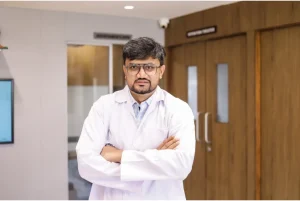
Dr Smit A. Desai
MDS (Oral & Maxillofacial Surgery), CDSRC Ahmedabad · Fellowship in Oral Oncology (AOMSI, 2017–19) · Travelling Fellowship in Head & Neck Oncology (FHNO, 2018).
Dr Smit practises as a consultant oral cancer surgeon in Ahmedabad, with a clinical focus on surgery of the oral cavity, jaws and neck, and on reconstruction that preserves speech, chewing and appearance. Oral submucous fibrosis sits squarely in that scope, both as a condition to treat and as one to keep under review.
What affects the cost of OSMF treatment
We do not publish a price list, because the cost of oral submucous fibrosis treatment depends on what your tissue actually needs. These are the things that move it.
- Whether treatment is medical or surgical. A course of injections and physiotherapy sits in a different bracket from an operation.
- How many sessions are needed. Injection courses are given over weeks, and the number varies with response.
- The extent of release and resurfacing. Bilateral, dense bands take longer and need more cover than a limited release.
- Anaesthesia and length of stay. Day-care and inpatient care are costed differently.
- Investigations. Blood tests and, where indicated, a biopsy with histopathology.
- Follow-up and physiotherapy aids. Review visits over the following months, and any stretching device.
Insurance cashless and reimbursement are supported, and the team helps with pre-authorisation. Government schemes are not accepted. For how we handle cost conversations generally, see oral cancer treatment cost in India.
Oral submucous fibrosis treatment in Ahmedabad
Heyansh Oral Cancer Hospital runs three clinics across Ahmedabad, so review visits stay practical over the long term.
Maninagar
Ahmedabad 380008
Satellite
Nikol / New Naroda
Full addresses and directions are on the branches and contact numbers page, and there is a dedicated page for the Nikol clinic.
Frequently asked questions
Is OSMF curable completely?
No. Fibrous tissue that has already formed does not turn back into normal lining, and any product promising a complete cure is overstating it. What treatment reliably does is halt progression, settle the burning and improve how wide your mouth opens.
Is OSMF stage 1 curable?
Early OSMF responds best, and many people at this stage regain comfortable opening with injections, nutritional support and daily stretching alone. It is still not a cure in the sense of the tissue becoming normal again, and it only holds if areca nut stops completely.
Can OSMF be cured naturally or at home?
Stopping areca nut and doing your stretching routine at home are genuinely the two most powerful things you can do, and no treatment works without them. But home measures alone will not soften dense bands, and they leave nobody examining the lining for early change.
Can OSMF turn into cancer?
It can. OSMF is classed as a potentially malignant disorder, which means oral cancer can develop in affected mucosa, although most people with OSMF do not develop it. This is the reason for periodic review rather than one-off treatment.
How do I know if I need surgery?
Surgery is generally discussed when mouth opening stays severely restricted and the bands are too dense to respond to injections and stretching. The decision is made on measured opening and examination, not on how long you have had symptoms.
How much does oral submucous fibrosis treatment cost?
It depends mainly on whether you need a course of medical treatment or an operation, how extensive the release and resurfacing are, and what investigations are required. You will be given a realistic figure for your own situation at the consultation, and insurance pre-authorisation is supported.
Will my mouth opening come back to normal after surgery?
Most people gain a substantial, usable improvement rather than a return to a completely normal measurement. How much you keep depends heavily on doing the mouth-opening exercises and staying off areca nut.
Does OSMF come back after treatment?
It can re-scar, and the two things that drive that are stopping the stretching routine too early and going back to chewing. This is why physiotherapy is treated as part of the operation rather than aftercare.
Which doctor treats oral submucous fibrosis?
An oral and maxillofacial surgeon manages OSMF, and where the condition is being watched for malignant change, one with head and neck oncology training. At Heyansh you are seen by Dr Smit A. Desai, who holds fellowships in both oral oncology and head and neck oncology.
Is plain supari without tobacco still a problem?
Yes. Areca nut itself drives the fibrosis, so plain supari, mawa and tobacco-free pan masala all contribute. This catches a lot of people out, because they have already given up tobacco and assume they are in the clear.
Book a consultation
Bring any previous reports. Your mouth opening will be measured, the lining examined, and the options explained in plain language.
Email drsmitdesai111@gmail.com · See all branches and contact numbers · Read more on the Heyansh blog
Medically reviewed by Dr Smit A. Desai, MDS (Oral & Maxillofacial Surgery), Fellowship in Oral Oncology (AOMSI), Travelling Fellowship in Head & Neck Oncology (FHNO).
This page is general health information about oral submucous fibrosis and its treatment. It is not a diagnosis and does not replace an in-person examination. Measurements, stages and treatment choices vary from person to person.
Last reviewed: 28 October 2026