
Tongue cancer surgery explained
Types of Glossectomy: How Much Tongue Is Removed?
Dr Smit A. Desai — Consultant Oral Cancer Surgeon · MDS (OMFS) · Fellowships in Oral Oncology (AOMSI) & Head & Neck Oncology (FHNO)
Expert tongue cancer surgery that removes the cancer completely and rebuilds your tongue in the same operation — protecting your ability to speak, eat and look like yourself.
Key takeaways
- There are four main types of glossectomy: partial, hemiglossectomy, subtotal (or near-total) and total. They differ in how much of the tongue is removed.
- Most people with tongue cancer need only part of the tongue removed. Total glossectomy is kept for large, advanced cancers.
- Doctors now use a more exact glossectomy classification, Types I to V, based on how deep the cancer goes into the tongue’s layers and muscles — not just how wide it is.
- Different websites give different fractions for the same name. That is why it helps to ask your surgeon exactly what will be removed and what will stay.
- The less tongue removed, the easier speech and eating usually are afterwards. Larger removals are rebuilt with tissue from elsewhere, and therapy helps you adapt.
- Finding the cancer early is what keeps the operation small.
What are the types of glossectomy?
The word comes from Greek: glossa means tongue and -ectomy means to cut out. So “glossectomy” on its own only tells you the tongue is being operated on. The word in front of it — partial, hemi, subtotal, total — is what tells you how much.
Surgeons choose between the types of glossectomy for one main reason: to remove all of the cancer with a rim of healthy tissue around it, called a margin, while keeping as much working tongue as possible. A bigger operation is never chosen for its own sake. It is chosen when a smaller one would leave cancer behind.
The good news, and the thing most families want to hear first, is this: most people with tongue cancer do not lose their whole tongue. When the cancer is found early, a partial glossectomy is usually enough.
How much tongue is removed in each type?
Here are the common types of glossectomy side by side. The amounts are a guide. Your surgeon decides the exact area from your examination, scans and biopsy.
Swipe left to see the full table →
| Type | How much tongue is removed | Usually used for | How the wound is usually closed |
|---|---|---|---|
| Partial glossectomy |
A small section, usually much less than half, taken with a margin of healthy tissue | Small, early cancers and some precancerous patches | Stitched directly, left to heal, or covered with a thin skin graft |
| Hemiglossectomy |
About one half — the left or right side of the tongue | Cancers that go deeper into one side but do not cross the middle | Often rebuilt with a thin, flexible flap of tissue |
| Subtotal / near-total glossectomy |
More than half, but some tongue is kept, often part of the back (base) | Larger cancers that cross the middle line of the tongue | Rebuilt with a bulkier flap to fill the space |
| Total glossectomy |
The whole tongue, including the base | Large, advanced cancers affecting both sides and the base | Rebuilt with a large flap; feeding and breathing support at first |
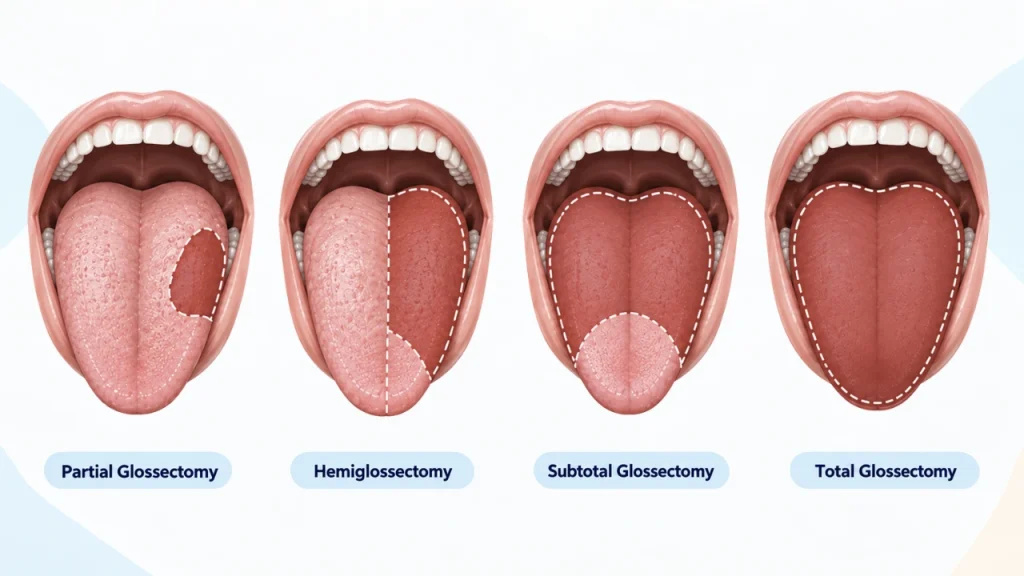
You may also hear older or less common names. A wedge or cuneiform glossectomy is a small V-shaped partial removal. A marginal glossectomy removes a strip along the edge of the tongue. An anterior glossectomy removes the front part, including the tip. All of these sit within the partial group.
The glossectomy classification doctors use: Types I to V
The names above are useful, but they are loose. In 2019, surgeons at the European Institute of Oncology published a more exact glossectomy classification in the journal Head & Neck, led by Dr Mohssen Ansarin. Experts from Memorial Sloan Kettering Cancer Center in New York and two other major cancer centres reviewed and endorsed it.
This glossectomy classification does not use fractions. Instead, it is based on which layers and muscles of the tongue the cancer has reached. It helps to know two words first:
- Intrinsic muscles — the small muscles inside the tongue that change its shape.
- Extrinsic muscles — the larger muscles that anchor the tongue to the jaw, the hyoid bone in the neck and the skull, and move it around.
The tongue is also two mirror-image halves joined in the middle. Each half has its own muscles, blood supply and nerves. That is why crossing the middle line is such an important dividing point.
Swipe left to see the full table →
| Type | Common name | What is removed | Used when the cancer… |
|---|---|---|---|
| Type I | Mucosectomy | The surface lining and the layer beneath it, with a thin slice of the inner muscle | is a precancerous or very superficial patch on the surface only |
| Type II | Partial glossectomy | The lesion plus the inner (intrinsic) muscles, down to where the outer muscles begin | has gone a short way into the tongue — less than 10 mm deep |
| Type IIIa | Hemiglossectomy | One side of the tongue, including the inner and outer muscles on that side; the base is kept | is deeper than 10 mm but stays on one side |
| Type IIIb | Compartmental hemiglossectomy | The whole muscle "compartment" of one side, up to the middle line, with its nerves and blood vessels in one piece | has spread heavily through the muscles of one side |
| Type IVa | Subtotal glossectomy | The front of the tongue across both sides; both sides of the base are kept | has crossed the middle into the other side, but stays in the front, movable tongue |
| Type IVb | Near-total glossectomy | As Type IVa, plus the base of the tongue on the affected side; the working base on the other side is kept | has crossed the middle and also reached the base on its own side |
| Type V | Total glossectomy | The whole movable tongue and the base, down to the space just above the voice box | affects the deep muscles on both sides and limits how the tongue moves |
A note if you have read about this elsewhere: some online summaries describe Type IVb wrongly. In the original paper, it keeps the working base of the tongue on the less affected side — and that piece matters a great deal for swallowing.
You do not need to memorise this glossectomy classification. But if your report says “Type IIIa” or “compartmental”, this table tells you what it means.
Why do sources give different numbers for the same type?
If you have searched the types of glossectomy before, you may have found that websites do not agree. That is not your mistake. They really do contradict each other:
- The US National Library of Medicine’s StatPearls describes a partial glossectomy as removing less than half of the tongue.
- Johns Hopkins Medicine says it usually means up to one-third.
- Some textbooks use a four-step scale: under one-third is partial, one-third to one-half is hemi, one-half to three-quarters is subtotal, and more than three-quarters is total.
The reason is simple: for decades there was no agreed definition. The authors of the 2019 paper looked through more than 700 published studies and found that names like “hemiglossectomy” were almost never tied to a precise amount. Two surgeons could use the same word for quite different operations.
Fractions are also tricky because the tongue is three-dimensional. A cancer can look small on the surface but go deep into the muscle. Removing it safely might take a small area of surface but a large share of muscle underneath. That is why the newer types of glossectomy are defined by depth and muscles, not fractions.
So what should you do? Do not rely on a fraction from the internet. Ask your surgeon to show you, on a picture or diagram, which part will be removed and which part will stay. That one conversation will tell you more than any definition.
What decides which type of glossectomy you need?
Your surgeon looks at several things together before choosing between the types of glossectomy:
- How deep the cancer goes. Doctors call this the depth of invasion: how far the cancer has grown down into the tongue from the surface. It is now part of how tongue cancer is staged. A cancer under about 10 mm deep can often be treated with a partial glossectomy. A deeper one usually needs more.
- How wide it is on the surface. A wider cancer needs a wider area removed to leave a clear margin.
- Whether it crosses the middle of the tongue. Once a cancer reaches the other half, a hemiglossectomy is no longer enough.
- Whether it reaches the base (back) of the tongue, the floor of the mouth or the jaw. These change both the size of the operation and how the surgeon reaches the cancer.
- The margin needed. The aim is a rim of healthy tissue all round. The 2019 paper suggests roughly 1.5 cm on the surface for a partial glossectomy. The tissue is then checked under a microscope after surgery.
To measure these things, your team will usually use a biopsy, a careful examination by hand, and a scan — most often an MRI or CT. The scan shows which muscles the cancer has reached, and that is what links your cancer to a type in the glossectomy classification.
This is also why timing matters so much. A cancer caught while it is small and shallow can often be removed with a partial glossectomy. Weeks of waiting can let it grow deeper and push the operation up a level. If you have a tongue ulcer that has not healed in two to three weeks, read our guide to the signs and symptoms of oral cancer and get it checked.
Speaking and eating after each type of glossectomy
This is usually the biggest fear, so we will be direct. Everyone’s recovery is different. But the pattern across the types of glossectomy is clear: the more tongue is kept, the easier speech and eating usually are.
After a partial glossectomy
Most people speak and eat by mouth again. Some sounds take practice at first, and soft food helps while the mouth is sore. Within a few months, many people find others barely notice a difference.
After a hemiglossectomy
The remaining half of the tongue learns to do more of the work, and a flap keeps the tongue’s shape. Speech is usually understandable, though some sounds can stay less crisp. Swallowing therapy makes a big difference.
After a subtotal or near-total glossectomy
This is a bigger change. A bulkier flap helps the remaining tongue push food and shape sounds. Many people return to eating by mouth, often softer textures, after a period with a feeding tube. Speech therapy is a core part of recovery.
After a total glossectomy
Life without a tongue is possible, and people do adapt. A large flap rebuilds the floor of the mouth. At first, a temporary breathing tube in the neck (a tracheostomy) and a feeding tube are common. With therapy, some people return to soft or liquid food by mouth, and many can be understood by those closest to them.
How the gap is closed: reconstruction after glossectomy
Every one of the types of glossectomy leaves a gap. How it is closed depends mainly on its size:
- Stitching directly or letting it heal on its own — for small partial glossectomies. The tongue heals well and quickly.
- A thin skin graft — sometimes used to cover a shallow surface wound.
- A local flap — nearby tissue rotated into place, used for some medium-sized defects.
- A free flap — healthy skin and tissue taken from the forearm or thigh, with its own artery and vein. These are joined to blood vessels in the neck under an operating microscope. A thin forearm flap suits a hemiglossectomy because it stays flexible. A bulkier thigh flap is often used after subtotal and total glossectomy to fill the space.
Operations that often go with a glossectomy
A glossectomy is often only one part of the plan. You may hear these terms too:
Neck dissection
Tongue cancer can spread to the lymph nodes in the neck early, sometimes before they can be felt. So the surgeon often removes and checks the lymph nodes on one or both sides of the neck in the same operation. This is called a neck dissection. The result also guides whether further treatment such as radiotherapy is needed.
How the surgeon reaches the cancer
- Through the mouth (transoral) — for most small, front-of-tongue cancers. No cut on the face or neck is needed for the tongue itself.
- Pull-through approach — the tongue is reached from below, through the neck, for deeper or further-back cancers.
- Mandibulotomy — the lower jaw is divided temporarily to give access to the back of the tongue, then fixed back with small plates.
Extended or composite resections
If the cancer has spread beyond the tongue, the operation can be “extended” to include the floor of the mouth, part of the jawbone or part of the throat. In India these larger operations are sometimes called a commando operation. When bone is removed, it can be rebuilt as well — read more on our maxillofacial surgery page.
Cancer that starts in the base of the tongue is classed as throat (oropharyngeal) cancer and is often treated differently, sometimes without surgery first.
Glossectomy for reasons other than cancer
Not every glossectomy is for cancer. Two other uses come up in searches:
- Reduction glossectomy — to reduce an abnormally large tongue (macroglossia), sometimes in children born with certain conditions.
- Midline glossectomy — occasionally used in some people with obstructive sleep apnoea, to open the airway behind the tongue.
These are planned very differently, and the types of glossectomy above do not apply to them. This article, and the work of Heyansh Oral Cancer Hospital, focuses on tongue and mouth cancer.
Questions to ask your surgeon before a glossectomy
Most people think of their questions on the way home. Take this list to your appointment, or screenshot it.
- Which type of glossectomy are you planning, and why that one?
- Can you show me on a diagram which part will be removed and which part will stay?
- How deep is the cancer, and does it cross the middle of the tongue?
- Will you remove lymph nodes from my neck as well?
- How will the gap be closed, and will I need a feeding or breathing tube?
- What will speaking and eating realistically be like after three months, and who helps with therapy?

Dr Smit A. Desai
MDS (Oral & Maxillofacial Surgery) · Consultant Oral Cancer Surgeon, Ahmedabad
The source file states that Dr Smit performed Pawan Kumar's surgery and has followed him for the six years since. He has over ten years of experience operating on cancers of the mouth, jaws and neck and fellowship training in oral oncology and head and neck oncology.
- Fellowship in Oral Oncology (AOMSI, 2017–19)
- Travelling Fellowship in Head & Neck Oncology (FHNO, 2018)
- Member: AOMSI, IAOO, IAOMS, FHNO
- 8,000+ patients treated
- Full profile and training
Want to know which type of glossectomy your scans point to? Bring your biopsy report and MRI or CT to Dr Smit A. Desai. He will explain, on a diagram, how much of the tongue needs to come out and how it will be rebuilt — or review a plan you have already been given. Read more about tongue cancer surgery at Heyansh Oral Cancer Hospital, with three clinics in Ahmedabad.