- 29
- Sep
Oral Cancer Treatment Success Story in Ahmedabad
khushbu.darji@zerodimensions.in Case Study No CommentsOral Cancer Treatment Success Story in Ahmedabad: Pawan Kumar, Six Years On
He came from Uttar Pradesh with mouth ulcers that would not heal. Several doctors treated them. Nobody biopsied them. Six years after his surgery at Heyansh Oral Cancer Hospital, he eats normally and is still clear.
~11 min read
Pawan Kumar travelled from Uttar Pradesh to Ahmedabad with mouth ulcers that several doctors had treated and none had biopsied. A biopsy at Heyansh Oral Cancer Hospital confirmed oral cancer. Dr Smit A. Desai operated. Six years later he eats normally, lives an ordinary life with his family, and comes back every six months for a check-up — with no recurrence.
Key takeaways from this case
- The first sign was the most ordinary one. Mouth ulcers that kept coming back and would not heal.
- Only a biopsy settled it. A tissue sample confirmed what repeated treatment had not.
- One properly planned operation did the job. Cancer removal, neck management when needed, and reconstruction are planned together.
- Six years matters clinically. Most oral cancer recurrences happen in the first two years.
- He still comes back every six months. Long-term follow-up remains part of the plan.
- He travelled from another state for treatment and continues to return for review.
- The case at a glance
- Pawan in his own words
- It started as an ulcer that would not heal
- Doctor after doctor, and no biopsy
- The biopsy that named it
- Why he came from UP to Ahmedabad
- The surgery Dr Smit A. Desai performed
- Recovery: the first weeks, the first year
- Six years on: eating, working, normal
- Why six years clear matters
- The six-monthly check-up
- What this case teaches
- His message to anyone with an ulcer
- FAQ
The case at a glance
- Patient
- Pawan Kumar
- Came from
- Uttar Pradesh — travelled to Ahmedabad, Gujarat for treatment
- First complaint
- Mouth ulcers that kept returning and would not heal
- Seen before Heyansh
- Several doctors across multiple visits — treated as ordinary ulcers, with no biopsy taken
- How it was diagnosed
- Biopsy at Heyansh Oral Cancer Hospital confirmed oral cancer
- Treating surgeon
- Dr Smit A. Desai, MDS (OMFS), Consultant Oral Cancer Surgeon
- Follow-up since
- Every six months, ongoing
- Status today
- Six years clear. Eating normally, no problems reported, living an ordinary family life.
Pawan Kumar tells his own oral cancer survivor story
It started as a mouth ulcer that would not heal
There was no lump he could feel and no pain he could not live with. There were ulcers in his mouth. They came, they stayed, and they did not go away the way mouth ulcers are supposed to.
Almost everyone gets mouth ulcers. A small sore often clears inside a week or two. That is why early oral cancer can be missed: at first, it may resemble an ordinary problem.
A sore or patch in the mouth that has not healed in two to three weeks needs proper assessment.
What the evidence says about a non-healing ulcer
A 2026 review of early warning signs found that a lesion lasting longer than two to three weeks is a common presentation of oral squamous cell carcinoma, and that a painless non-healing ulcer with no obvious cause needs urgent referral and biopsy.
Source: Red flags of oral cancer: unravelling the early symptoms — a literature review (ScienceDirect, 2026).
He saw doctor after doctor, and nobody took a biopsy
Pawan Kumar did not sit at home ignoring the problem. He went for help repeatedly, to more than one doctor, over a stretch of time. He was treated for mouth ulcers each time because that is what everyone assumed they were seeing.
Nobody sent a piece of it to a laboratory.
Early oral cancer can resemble something harmless. When an ulcer has not healed after several weeks, the question changes from repeated treatment to whether tissue needs to be examined.
How long the system usually takes
One analysis of the diagnostic pathway found a median health-system interval of about three months and discusses delayed diagnosis as a major problem in oral cavity cancer.
Source: An Analysis of the Timeline to Diagnosis and Treatment in Oral Cavity and Oropharynx Cancer (PMC).
The biopsy that finally named it: oral cancer
At Heyansh Oral Cancer Hospital the ulcers were examined and a biopsy was advised.
A small sample of suspicious tissue is removed and sent to a pathology laboratory to be examined under a microscope. Scans show where disease is and how far it may have spread; the biopsy establishes what the tissue is.
Pawan’s biopsy came back positive for oral cancer.
If you have just been told you have oral cancer
Bring the biopsy report and scans to your treating team. Those documents let the surgeon discuss a concrete treatment plan rather than a general possibility.
Why he came from Uttar Pradesh to Ahmedabad
Pawan Kumar is from Uttar Pradesh. He did not have his surgery near home — he travelled to Ahmedabad for it, and six years later he still makes the journey every six months for his check-up.
For families considering travel, practical questions include whether the treating team specialises in oral cancer and whether cancer removal and reconstruction are planned together when reconstruction is needed.
Send reports first
Biopsy report and scans can be reviewed before a family plans travel.
Group the visit
Consultation, tests and treatment planning can be coordinated to reduce unnecessary repeat trips.
Three branches
Maninagar, Satellite and Nikol in Ahmedabad.
The surgery pathway Dr Smit A. Desai uses for operable oral cancer
Assessment and planning
Examination of the mouth and neck, review of the biopsy, and imaging to understand the tumour and the neck before the operation.
Removing the cancer with a clear margin
The goal of oral cancer surgery is to remove the tumour with an adequate rim of healthy tissue around it.
Assessing and treating the neck when indicated
Oral cancers can spread to lymph nodes in the neck. Neck treatment is planned according to the site, stage, imaging and pathology.
Reconstruction when required
Reconstruction can be planned in the same operation to protect speech, swallowing and appearance.
Final pathology and the next decision
The removed specimen is examined in full. That pathology report helps determine whether any additional treatment is needed.
Recovery: the first weeks, and the first year
Recovery happens at different speeds. Physical healing is measured in weeks: wounds settle, swelling falls, and food progresses from liquid to soft to normal. Functional recovery can take months: chewing confidently, speaking comfortably and eating socially again.
Do patients really get function back?
A 12-month study of patients who had surgery for tongue cancer found that quality of life fell most in the first month and returned toward baseline over the following year; 77% had normal or near-normal function at 12 months.
Source: Quality of Life in Patients With Tongue Cancer After Surgical Treatment (PMC).
Six years on: eating normally, and enjoying his family
Six years after his operation, Pawan Kumar’s own summary of his life is ordinary — and that is the point of the case.
He eats properly and spends time with his family. The source file states that he has not reported a problem in those six years that traces back to the cancer or surgery.
He continues to return for follow-up rather than treating the end of surgery as the end of cancer care.
Two other patient stories are also published on this site: a seven-year survivor story and a recovery from oral cancer surgery at the age of 80.
Why six years clear means more than it sounds
Oral cancer recurrence is not distributed evenly over time. The risk is highest in the period soon after treatment and falls with time.
When oral cancer actually comes back
In one study of oral squamous cell carcinoma recurrence, 50.6% of recurrences happened within six months of finishing treatment, 72.5% within one year, and 88.6% within two years.
Source: Tumor Recurrence and Follow-Up Intervals in Oral Squamous Cell Carcinoma (PMC).
The six-monthly check-up he has never skipped
Pawan Kumar still comes to Heyansh every six months, six years on, travelling from Uttar Pradesh to do it.
Follow-up looks for recurrence, new lesions elsewhere in the mouth and longer-term functional problems that may need treatment.
The standard follow-up schedule
Widely used NCCN surveillance guidance is commonly summarised as review every 1–3 months in the first year, every 2–6 months in the second year, and every 4–8 months through years three to five, with longer intervals later.
Source: Personalizing Surveillance in Head and Neck Cancer (ASCO Educational Book).
Treated elsewhere and due for a review? Heyansh also sees follow-up patients operated elsewhere.
Book a Follow-UpWhat Pawan Kumar's case teaches about oral cancer
- A mouth ulcer that will not heal is a biopsy question. A persistent lesion needs diagnosis, not repeated treatment without reassessment.
- Being treated is not the same as being diagnosed. Pawan was treated several times before a biopsy established what was happening.
- A painless sore is not automatically reassuring. Persistent oral lesions still need assessment even when pain is absent.
- The first operation needs careful planning. Cancer removal, neck management when indicated and reconstruction are planned as one pathway.
- Removal and rebuilding belong in the same plan. Reconstruction is considered from the start when required.
- Follow-up continues long after treatment. The highest recurrence risk is early, but surveillance continues beyond the first few years.
His message to anyone with an ulcer that will not heal
The source file describes Pawan Kumar’s message as being aimed at people who keep going from clinic to clinic for a sore that does not heal.
The useful next step is simple: have a persistent lesion assessed by someone who treats oral cancer, and let the clinician decide whether it needs a biopsy. Most mouth ulcers are not cancer, but persistent ulcers need a definite explanation.
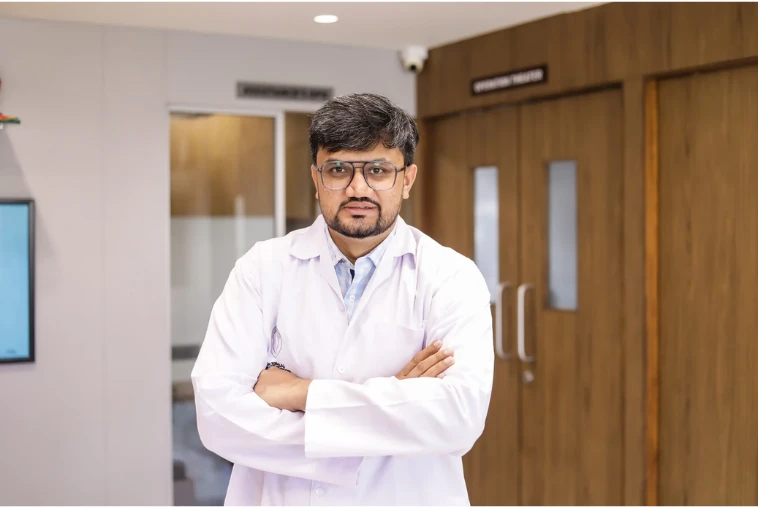
Dr Smit A. Desai
MDS (Oral & Maxillofacial Surgery) · Consultant Oral Cancer Surgeon, Ahmedabad
The source file states that Dr Smit performed Pawan Kumar's surgery and has followed him for the six years since. He has over ten years of experience operating on cancers of the mouth, jaws and neck and fellowship training in oral oncology and head and neck oncology.
- Fellowship in Oral Oncology (AOMSI, 2017–19)
- Travelling Fellowship in Head & Neck Oncology (FHNO, 2018)
- Member: AOMSI, IAOO, IAOMS, FHNO
- 8,000+ patients treated
- Full profile and training
Why patients choose Heyansh Oral Cancer Hospital
Oral cancer focus
The clinic focuses on diagnosis and treatment of oral and head-and-neck cancer.
Biopsy before assumptions
Persistent suspicious lesions are assessed for biopsy when clinically indicated.
Removal and reconstruction planned together
Reconstruction can be planned from the start when required.
Out-of-state patients welcome
Reports can be sent first so families can discuss the case before travelling.
Second opinions
Patients can bring existing biopsy reports and scans for review.
Three Ahmedabad branches
Maninagar, Satellite and Nikol / New Naroda.
Have an ulcer that won't heal? Get it looked at properly
Send your biopsy report or scans for a review, including a second opinion if you already have a plan from somewhere else.
Branch numbers: 087349 54487 (Maninagar) · 099983 19470 (Satellite, also WhatsApp) · 098983 48601 (Nikol) · drsmitdesai111@gmail.com
